

Cultivated meat taste depends heavily on the growth media used during production. This nutrient-rich solution provides cells with essential components like glucose, amino acids, and vitamins, which influence flavour, texture, and cooking behaviour. Here's a quick breakdown:
- Flavour: Amino acids like glutamic acid enhance savoury umami notes, while fats contribute to richness and aroma. However, cultivated meat can taste sweeter or lack depth due to lower inosine-5'-monophosphate (IMP) levels.
- Texture: Growth media impacts connective tissue proteins like collagen, affecting meat's firmness and chewiness.
- Cooking: Nutrients in the media enable the Maillard reaction, creating browned surfaces and complex aromas.
Tailoring growth media formulations for specific species and meat types is key to achieving the taste and texture consumers expect. Advances in nutrient customisation and cost reduction are helping close the sensory gap between cultivated and conventional meat.
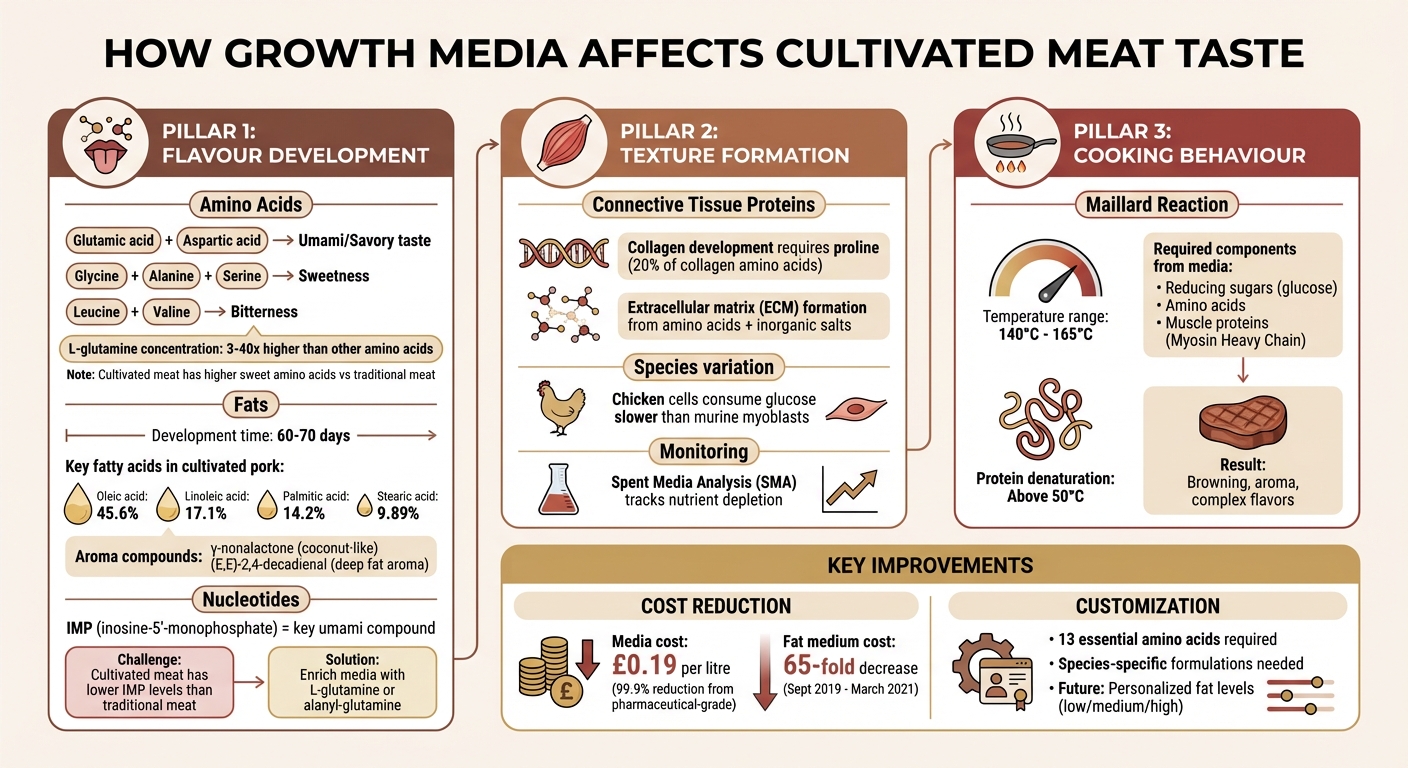
How Growth Media Components Influence Cultivated Meat Flavor Profile
Dr. David Block: Developing optimized media for cultivated meat production
sbb-itb-c323ed3
How Growth Media Nutrients Affect Flavour
The nutrients in growth media are essential not only for cell growth but also for shaping the flavour of cultivated meat. Three components - amino acids, fats, and nucleotides - work together to deliver the sweetness, savouriness, and richness we associate with meats like beef, chicken, and pork.
Amino Acids and Taste Development
Amino acids are more than just the building blocks of proteins - they play a major role in how meat tastes. Different amino acids create distinct flavour sensations. For example, glutamic acid and aspartic acid are responsible for the savoury umami taste, while glycine, alanine, and serine add sweetness. On the other hand, leucine and valine contribute a bitter edge.
Getting the balance right is crucial. Studies reveal that cultivated meat often contains higher levels of sweet amino acids compared to traditional meat, which can make it taste sweeter [3]. At the same time, not having enough aspartic acid can reduce the umami intensity [3]. To address this, producers adjust growth media to boost the levels of glutamic and aspartic acids, ensuring the savoury depth consumers expect.
"Since the umami attribute of meat is important for good taste, simulating glutamic acid and aspartic acid, which are known to be closely correlated to umami is important." - Seon-Tea Joo et al., Researchers [3]
Unlike conventional meat, cultivated cells lack the nutrient delivery systems found in living animals. This makes it necessary to include 13 essential amino acids in the culture media, such as arginine, glutamine, and histidine [1]. Among these, L-glutamine is often added in concentrations 3 to 40 times higher than other amino acids because it is vital for protein production and flavour development [1].
Next, let’s look at how fat contributes to the overall flavour complexity.
Fat Formation and Flavour Depth
Fat plays a key role in giving meat its richness, holding onto aroma compounds, and ensuring flavours linger during and after cooking. With cultivated meat, growth media can be customised to influence the fat's flavour profile - something that takes 60 to 70 days of specific feeding in livestock [4].
In October 2025, researchers at Tufts University found that adding 3.0 mg/mL of myoglobin to porcine fat cells increased key aroma compounds like γ-nonalactone (a coconut-like scent) and (E, E)-2,4-decadienal (a deep fat aroma). These findings, verified through advanced chromatography techniques, highlight how cultivated meat can achieve a more complex flavour profile [4].
The primary fatty acids in cultivated pork fat include:
- Oleic acid: 45.6%
- Linoleic acid: 17.1%
- Palmitic acid: 14.2%
- Stearic acid: 9.89% [4]
When these lipids oxidise during cooking, they combine with Maillard reaction compounds to create the diverse aromas we associate with cooked meat.
"An important potential advantage of cultivated meat technology is in the ability to tailor aroma and nutritional content during cell cultivation due to the direct access of the media to the cells." - Natsu Sugama et al., Tufts University [4]
Finally, nucleotides complete the flavour profile by amplifying the savoury notes.
Nucleotides and Savoury Taste
Nucleotides, particularly inosine-5'-monophosphate (IMP), are critical for the brothy, umami flavour that defines meat. These compounds are released during cooking and vary depending on the species and cut. Growth media provides the building blocks for nucleotide synthesis, such as L-glutamine, which supports the production of these nitrogen-based molecules.
However, cultivated meat currently contains lower levels of IMP compared to traditional meat, which weakens its savoury profile [3].
"The umami intensity of CMT was weaker than that of TM due to the lower concentration of IMP." - Seon-Tea Joo et al., Researchers, Food Science of Animal Resources [3]
To address this, producers can enrich growth media with higher levels of L-glutamine or stable compounds like alanyl-glutamine. Adjusting amino acid ratios and closely monitoring IMP levels using advanced chromatography ensures cultivated meat can match the savoury depth of conventional meat, enhancing the overall taste experience.
Growth Media's Effect on Texture and Cooking Behaviour
When it comes to cultivated meat, growth media does more than influence flavour - it’s central to creating the structural proteins that define texture and cooking behaviour. Packed with amino acids, salts, and vitamins, the media provides the essential components for forming connective tissue and muscle fibres. These elements also serve as precursors for browning and aroma during cooking.
Connective Tissue Proteins and Texture
The texture of meat - whether tender or chewy - relies heavily on connective tissue proteins, such as collagen, and the muscle proteins formed during cell growth. Growth media supplies the amino acids and inorganic salts needed to build the extracellular matrix (ECM) [1].
One key player here is proline, which constitutes about 20% of the amino acids in collagen. This amino acid is vital for developing the connective tissue that contributes to meat's firmness [2]. Studies have shown that fibroblast cells in culture ramp up collagen production over time. Interestingly, proline levels increase in the spent media after seven days, reflecting both the production and breakdown of collagen [2].
"Proline in the media increased only in the cMFB culture after day 7. These data suggest that the cMFBs are differentiating and increasing the production and subsequent breakdown of collagen protein." - Nature Food [2]
However, not all cells or species share the same nutritional requirements. For instance, chicken muscle precursor cells consume glucose at a much lower rate than fibroblast cells or murine myoblasts [2]. This variability means that a one-size-fits-all formula for growth media won’t yield consistent textures across different types of cultivated meat. To address this, producers use Spent Media Analysis (SMA) to monitor nutrient depletion and adjust formulations, ensuring that cells have the right resources to develop the desired structural proteins [2].
These structural proteins are the foundation for the chemical transformations that occur during cooking.
Maillard Reaction During Cooking
Beyond texture, growth media also sets the stage for the Maillard reaction, the process responsible for the browning, aroma, and complex flavours of cooked meat. When cultivated meat is heated, proteins formed during cultivation interact with sugars, creating those appetising browned surfaces and rich aromas. This reaction typically takes place at temperatures between 140°C and 165°C [5][7].
Growth media contributes to this process by supplying key ingredients like reducing sugars (e.g., glucose) and amino acids, which are essential for the Maillard reaction [7][2]. It also promotes the development of muscle proteins such as Myosin Heavy Chain (MHC). These proteins denature and aggregate at temperatures above 50°C, giving cooked meat its firm, chewy texture [8].
In a notable advancement from July 2024, researchers at Yonsei University and Kangwon National University in South Korea created a gelatin-based "flavour-switchable scaffold" that incorporated furfuryl mercaptan, a compound linked to roasted meat aromas. When cultivated bovine tissue was heated to 150°C for five minutes, it released grilled beef flavours that closely resembled the Maillard reaction. An electronic nose analysis confirmed that the aromatic profile was similar to that of traditional cooked beef [5][6][8].
"Flavour is the most important thing to make cultured meat be accepted as real." - Milae Lee, Lead Author, Yonsei University [6]
This breakthrough highlights how growth media not only aids in developing reactive proteins but also allows for the integration of flavour-enhancing compounds. By addressing both texture and flavour, growth media ensures that cultivated meat delivers the sensory experience consumers anticipate. Together, these attributes form a complete and satisfying culinary experience.
Current Limitations and Improvement Methods
Cultivated Meat has made considerable progress, but it still falls short of replicating the exact taste and texture of traditional meat. The unique flavour and texture of conventional meat come from its intricate structure and post-mortem maturation - processes that are currently absent in Cultivated Meat production [10].
At its core, Cultivated Meat consists of controlled muscle cell cultures. This simplified structure can lead to noticeable differences in taste, such as increased bitterness or sourness [9]. Additionally, the lack of cell complexity impacts the overall sensory experience, creating textural inconsistencies. Another challenge is the absence of blood vessels in cultivated tissues, which hampers the uniform delivery of nutrients and affects consistency [12].
Reducing Flavour Differences
In March 2022, BioTech Foods, under the guidance of CTO Mercedes Vila, published findings in Scientific Reports comparing cultivated Frankfurt-style sausages and turkey breast to their supermarket counterparts. Using methods like Texture Profile Analysis and Rheology, the research revealed that Cultivated Meat products had similar hardness, cohesiveness, and springiness, placing them "within the range of traditional meat commercial products" [10].
"Understanding cultivated meat final characteristics such as texture is necessary for optimising the production and scalability phase." – Mercedes Vila, Co-founder and CTO, BioTech Foods [10]
Still, BioTech Foods noted that "cultured meat's organoleptic properties were anticipated to be different from traditional meat... its organoleptic development after the cell culture is under study" [10]. This underscores a key challenge: while texture can be engineered to match conventional meat, the absence of a maturation phase - which is essential for flavour development - remains a hurdle for Cultivated Meat.
Another factor influencing sensory quality is the cost of growth media. Significant progress has been made in reducing media costs, with models achieving prices as low as £0.19 per litre - a staggering 99.9% decrease from pharmaceutical-grade media [11]. This reduction is vital for producing affordable, high-quality Cultivated Meat at scale. However, achieving this requires removing unnecessary ingredients that could negatively impact flavour. Striking a balance between cost efficiency and precise nutrient control is critical to bridging the sensory gap between Cultivated Meat and its traditional counterpart.
To address these challenges, scientists are focused on refining nutrient formulations to improve flavour and texture.
Customising Growth Media for Better Taste
Efforts to improve taste are centred on optimising growth media. Scientists are using Spent Media Analysis (SMA) to identify the nutrients cells actually consume, allowing them to eliminate unused components that might contribute to undesirable flavours like bitterness or sourness [2]. Research shows that only a few components - such as glucose, arginine, glutamine, isoleucine, leucine, methionine, serine, and FGF2 - are significantly depleted during cultivation [2].
"CM will require targeted media formulation and optimisation efforts for each cell type, species, and bioprocess used for production." – Nature [2]
Species-specific optimisation is particularly important. For example, chicken muscle cells consume glucose more slowly and steadily compared to murine myoblasts, which use it rapidly and completely [2]. This highlights the inefficiencies of generic media formulations, which can lead to uneven growth and quality differences. Researchers are also exploring plant-based protein alternatives, such as mung bean or rapeseed isolates, to replace costly serum while ensuring the biological performance needed for authentic meat texture [13].
Advanced tools like Design of Experiments (DOE) and Response Surface Methodology (RSM) are helping to fine-tune the balance between cell growth and structural integrity. For instance, lamb muscle cell cultures grown in specific serum-free formulations (like LM8) have achieved proliferation rates comparable to those grown in media containing 20% foetal bovine serum [13]. These tailored approaches are steadily narrowing the sensory gap, making Cultivated Meat more appealing to consumers. Ultimately, customised growth media plays a pivotal role in delivering the taste and texture that people expect from meat products.
Conclusion: Growth Media and the Future of Cultivated Meat Taste
Growth media plays a central role in shaping the flavour of cultivated meat by providing essential components. From amino acids and nucleotides that build savoury depth to controlling fat deposition for aroma and richness, its impact closely aligns with the mechanisms discussed earlier. As Mark Post, Chief Scientific Officer at Mosa Meat, explains:
"Consumers only care about quality and price so we need to improve the full thickness of cultivated meat products. We need to improve the quality of muscle and fat to improve consumer acceptance and make meat as a commodity." [17]
Recent breakthroughs have made growth media not only more effective but also more affordable. For instance, the cost of fat medium dropped over 65-fold between September 2019 and March 2021, thanks to advances in serum-free formulations [17]. Companies like Mission Barns and Wildtype have already showcased products in the U.S., proving that tailored growth media can replicate the taste of traditional meat [16]. Meanwhile, cutting-edge analytical tools are refining these formulations, removing unnecessary ingredients and achieving a fine balance between growth and texture.
Looking forward, personalisation is set to revolutionise the industry. By tweaking insulin and fatty acid levels in growth media, producers can cater to individual preferences, offering meat with varying fat levels - low, medium, or high [14]. Gyuhyung Jin, from the Davidson School of Chemical Engineering at Purdue University, envisions a near future where:
"It may not be long until personalized cultured meat products with finely-tuned flavors, textures, and nutrients are available for sale" [14]
Consumer research already points to specific fat content as a key factor in satisfaction, highlighting the importance of precision in this area [15].
As these technological and scientific advancements progress, the sensory experience of cultivated meat continues to evolve. For UK consumers curious about the future of meat, platforms like Cultivated Meat Shop provide accessible, science-driven insights into taste, production, and availability. Together, these innovations are closing the taste gap, paving the way for a future where flavour, sustainability, and progress share the same plate.
FAQs
Why does Cultivated Meat sometimes taste sweeter than conventional meat?
Cultivated meat can have a sweeter taste because scientists can fine-tune biochemical processes, such as amino acid and nucleotide metabolism, which influence flavour. On top of that, when cooked, flavour compounds - particularly those from fat cells - can amplify the sweetness people perceive. This level of precise flavour control gives cultivated meat the ability to deliver taste profiles that stand apart from traditional meat.
How do producers boost umami in Cultivated Meat?
Producers work on boosting the umami flavour in cultivated meat by carefully managing amino acid metabolism. One method involves tweaking the culture medium to raise the levels of glutamic acid, a crucial compound that gives food its savoury, umami taste.
Will growth media affect how Cultivated Meat browns when cooked?
Yes, the type of growth media used can impact how cultivated meat browns when cooked. It plays a role in the biochemical processes that influence the development of meat flavours and aromas. This includes the Maillard reaction, which is crucial for browning and producing those deep, savoury flavours we associate with cooked meat.


