

If I had to sum it up in one line: soy can cost less when cell support cuts other inputs, while starch can cost less when structure cuts waste and growth factor use.
If you’re comparing these two scaffold types, the raw material price alone won’t tell you much. Both start cheap. The difference comes from processing, cell support, waste, growth factor use, and fit for the product type.
Here’s the short version:
- Soy often suits products where cell adhesion and protein function matter more.
- Starch often suits products where shape control and low waste matter more.
- Soy custom processing can add 40–60% over commodity inputs.
- Starch designs can cut material waste by up to 40%.
- Some scaffold setups can cut growth factor use by 25–30%.
- Growth factors are very expensive at £15,000–£30,000 per gram.
- Scaffold materials made up 18.5% of the 2025 Cultivated Meat ingredient market, worth £1.2 billion in the source figures.
So when I look at soy vs starch, I don’t ask, “Which feedstock is cheaper?” I ask, “Which one gets the tissue I need with fewer costly inputs?”
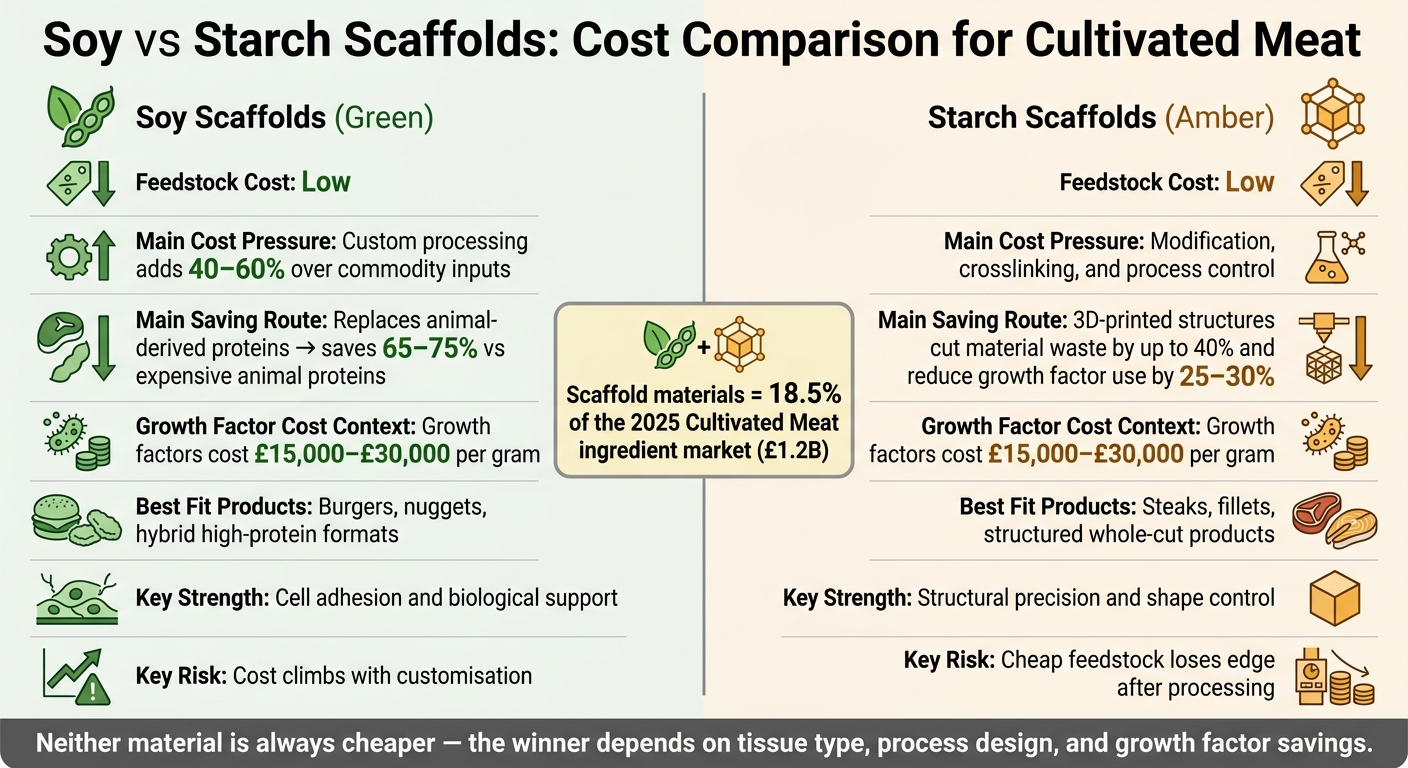
Soy vs Starch Scaffolds: Cost Comparison for Cultivated Meat
The Elements of Cultured Meat: Scaffolds 101 with Natalie Rubio | New Harvest 2017

sbb-itb-c323ed3
Quick Comparison
| Criteria | Soy scaffolds | Starch scaffolds |
|---|---|---|
| Starting material cost | Low | Low |
| Main cost pressure | Custom processing and tailored formats | Modification, crosslinking, and process control |
| Main saving route | Can replace costly animal-derived inputs | Can cut waste and reduce growth factor use |
| Best fit | Burgers, nuggets, hybrid high-protein formats | Steaks, fillets, other structured products |
| Main strength | Cell support | Structure control |
| Main risk | Cost climbs with customisation | Cheap feedstock can lose its edge after processing |
Bottom line: if you need biological support, I’d lean towards soy. If you need precise architecture with lower waste, I’d lean towards starch. Both approaches are vital for solving taste and texture challenges in structured products.
Soy scaffolds: plant protein with strong cell-support potential
Soy has strong cell-support potential, but shaping it for Cultivated Meat can get expensive fast. To turn soy into a usable scaffold, producers often need 3D bioprinting or other custom processing. That means tighter manufacturing controls, more specialist know-how, and customised formulations that can come with price premiums of 40–60% over commodity ingredients [1].
That cost shifts soy into a different lane. It tends to make more sense for high-value, structured Cultivated Meat, where cell support matters more than hitting the lowest possible input cost.
Common soy scaffold formats
The main cost split comes down to how much processing and customisation each format needs for different tissue types and production methods. At one end, you have minimally processed soy protein sheets. At the other, you have heavily engineered bioprinted constructs. Those sit firmly in the higher-cost, proprietary end of the market [1].
Put simply: the more tailored the format, the less soy acts like a commodity material.
Where soy adds value and where costs rise
Soy and other legume proteins can work as lower-cost substitutes for animal-derived or synthetic inputs, which helps their value case [1]. In the European Union, regulatory frameworks are also pushing the case for plant-based scaffolds, as animal-derived ingredients now face growing pressure for justification [1].
But there’s a trade-off. More customisation means more cost. So the core question is simple: does the added processing cost deliver enough extra performance to justify it? Soy tends to make sense when that extra performance matters. Starch, by contrast, usually fits better when feedstock cost carries more weight. It follows the lower-cost path, though its processing and performance limits can shift the balance.
Starch scaffolds: low feedstock cost with processing trade-offs
Starch is a low-cost plant polysaccharide. But turning that cheap raw input into a scaffold you can actually use is where costs start to creep in.
Common starch scaffold formats
In Cultivated Meat scaffolding, starch shows up in a few different formats, including gels, hydrogels, bioinks and 3D-printed structures.
Among these, 3D-printed starch structures can be one of the better options on cost. They can cut material waste by up to 40% (a key factor in reducing food waste) and speed up tissue development timelines. In some cases, they also reduce growth factor use by 25–30% [1]. That combination matters, because lower waste and nutrient delivery can make a noticeable difference to total production spend.
By comparison, starch systems that need tighter formulation control or more post-processing tend to give back some of that low raw-material price advantage.
Where starch saves money and where costs increase
Starch’s main upside is simple: the feedstock is cheap.
The catch is processing. Starch often needs modification, crosslinking and stricter process control to deliver consistent pore structure and mechanical strength [1]. Those extra steps don’t just add time. They add labour, inputs and manufacturing complexity too.
So a low-cost feedstock does not automatically mean a low-cost finished scaffold. With starch, the price edge tends to hold only when processing stays fairly simple. The next step is to compare starch directly with soy once those processing demands are factored in.
Soy vs starch: direct cost comparison
The key question isn’t which material looks cheaper on paper. It’s which one stays cheaper after processing is factored into cultivated meat production.
| Feature | Soy Scaffolds | Starch Scaffolds |
|---|---|---|
| Feedstock cost | Low | Low |
| Main cost advantage | Reduces supplement costs by replacing expensive animal-derived proteins | Reduces waste and growth factor use through structural precision |
| Structural tunability | Moderate; improving through hybrid biopolymer blends | High; well-suited to 3D bioprinting and pore-size control |
| Yield-related costs | Lowers costs by replacing expensive animal proteins | Lowers costs by reducing growth factor use |
Which is cheaper once processing is included
Neither material comes out ahead on raw cost alone. The difference shows up during production.
Soy can lower costs when it takes the place of expensive animal-derived supplements, with cuts of 65–75% compared with expensive animal-derived proteins [1]. That matters when growth factors can cost £15,000–£30,000 per gram [1].
Starch saves money in a different way. Its value shows up when processing can produce the required structure with less waste. Optimised scaffold designs can reduce growth factor use by 25–30% and cut material waste by 40% [1]. That’s why the cheaper option depends on the product you’re making, not just the input price. This economic balance is a core challenge within cellular agriculture and cultivated meat development.
Best-fit use cases for each material
Soy is often the better fit when cell adhesion and protein function matter most, such as in hybrid burgers, nuggets, and other high-protein products [1].
Starch-based scaffolds fit structured whole-cut products better, including steaks, fillets, and similar formats, where precise architecture helps keep material waste down [1].
Soy leads on biological function. Starch leads on structural precision and lower waste.
Conclusion: the right scaffold depends on the job
Soy and starch are both low-cost, plant-derived scaffold options. But one isn’t always cheaper than the other. The right pick depends on the R&D factors influencing production costs.
Soy gives stronger cell support, which makes it the practical option when protein content and cell adhesion matter most. Starch may look cheaper at the feedstock stage, but it often needs extra modification to deliver the structure you want. That extra processing can eat into the early cost edge. [1]
Put simply, soy leans towards biological support, while starch leans towards structural control. So the decision comes down to tissue type, process design, and how well the scaffold helps nutrient flow and cell development. [1] For Cultivated Meat producers, the best scaffold is the one that hits the tissue target with the fewest costly inputs, especially growth factors.
FAQs
Why isn’t the cheapest feedstock always the cheapest scaffold?
A low feedstock price doesn’t automatically lead to a low scaffold cost. The total cost also covers specialised formulation, processing, and purification steps, including decellularisation, which are needed for safety and structural integrity.
That means a scaffold with a slightly higher upfront price can still save money overall if it improves cell distribution, cuts ingredient use, and makes production more efficient.
When is soy more cost-effective than starch?
In cultivated meat production, soy-based scaffolds can cost less than starch-based options when producers use agricultural by-products and plant-derived materials in hybrid products.
Using lower-cost materials like soy, wheat and rice bran can also cut reliance on expensive biomass and synthetic scaffolds, which helps bring down overall production costs.
Which scaffold suits burgers and which suits steaks?
For cultivated meat, simpler products like burgers can often be made with suspension methods, so they may not need complex scaffolds.
By contrast, edible 3D scaffolds matter for structured cuts such as steaks. They give cells the three-dimensional support needed to form more complex tissue and texture.


