

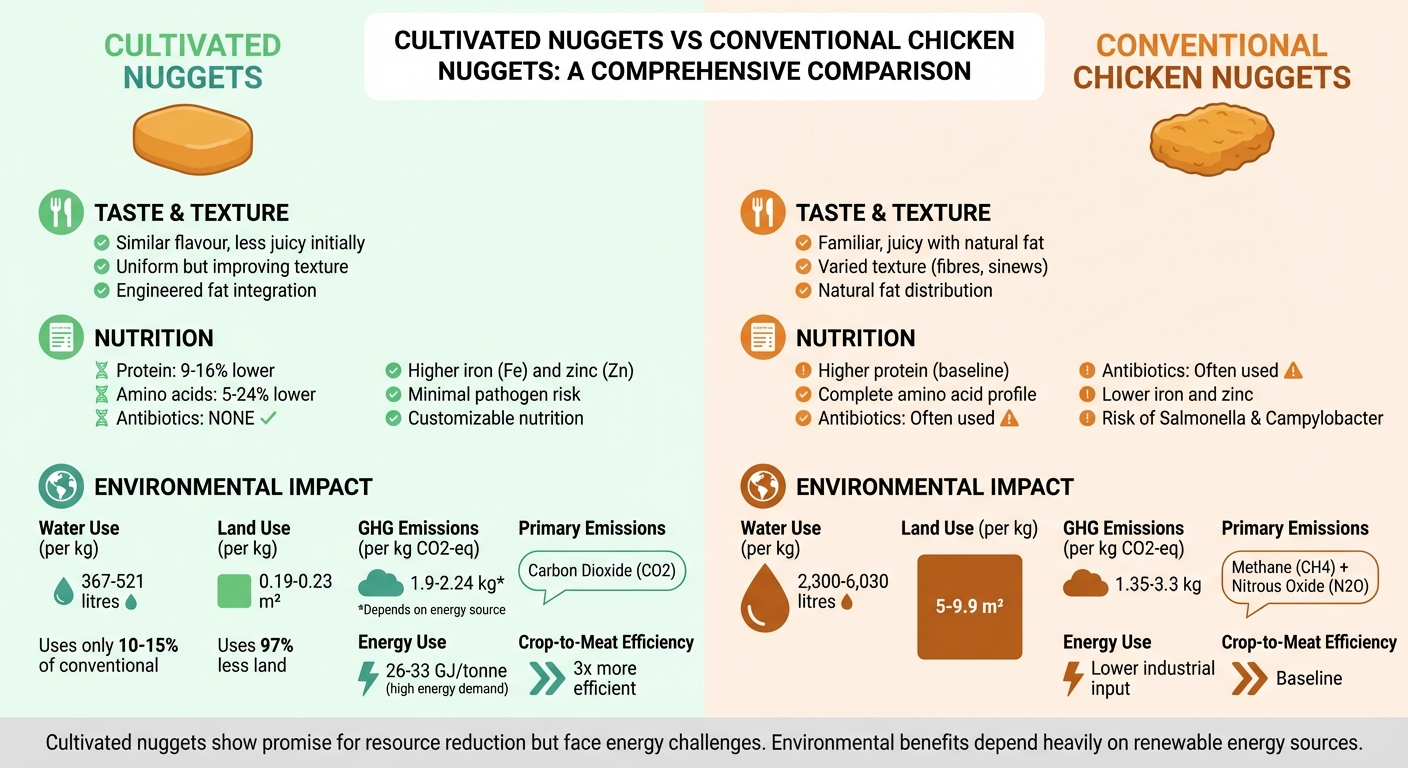
Cultivated chicken nuggets are made from real chicken cells grown in bioreactors, offering an alternative to conventional nuggets, which come from farm-raised chickens. Here's how they compare:
- Taste: Cultivated nuggets closely mimic the flavour of conventional nuggets but may lack juiciness due to differences in fat distribution.
- Texture: Advances in cell-growing technology have improved muscle structure, but some cultivated nuggets can feel more uniform compared to the varied texture of conventional nuggets.
- Nutrition: Cultivated nuggets can be tailored for higher mineral content (iron, zinc) but may have slightly less protein and amino acids. They are free from antibiotics and foodborne pathogens.
- Environmental Impact: Cultivated nuggets use far less land and water but require significant energy, especially if not powered by renewable sources.
Quick Comparison
| Factor | Conventional Nuggets | Cultivated Nuggets |
|---|---|---|
| Taste | Familiar, juicy with natural fat | Similar flavour, less juicy initially |
| Texture | Varied (fibres, sinews) | Uniform but improving |
| Protein | Higher | 9–16% lower |
| Antibiotics | Often used | None |
| Water Use | High (2,300–6,030 litres/kg) | Low (367–521 litres/kg) |
| Land Use | High (5–9.9 m²/kg) | Minimal (0.19–0.23 m²/kg) |
| GHG Emissions | 1.35–3.3 kg CO2-eq/kg | 1.9–2.24 kg CO2-eq/kg* |
*Dependent on energy sources.
Cultivated nuggets are a promising option for reducing resource use and animal farming concerns, but challenges like energy demands and consumer acceptance remain.
Cultivated vs Conventional Chicken Nuggets: Complete Comparison
Taste: Cultivated Nuggets vs Chicken Nuggets
How the Taste Compares
Cultivated nuggets are designed to match the flavour profile of traditional chicken. In sensory tests, these products have shown an impressive likeness to conventional chicken, both in taste and overall sensory experience [5]. Food scientists confirm that cultivated meat, when cooked, releases the same aroma through the Maillard reaction as conventional chicken does [5].
When compared side by side, the results are encouraging. JoNel Aleccia, a Health and Science Reporter at the Associated Press, shared her tasting experience:
It tastes like chicken... The aroma was enticing, just like any filet cooked in butter would be. And the taste was light and delicate with a tender texture. [8]
Thanks to advancements in 2024 and 2025, the flavour release at high temperatures has been fine-tuned, making cultivated nuggets even closer to their traditional counterparts [6]. But what about the subtle differences? Let’s take a closer look.
Where the Flavours Differ
While the flavour similarities are striking, texture introduces some noticeable differences. Early versions of cultivated nuggets lacked integrated fat, which made them less juicy compared to regular chicken nuggets [5][7]. This is because cultivated meat requires separate cultivation of muscle and fat cells, and the way these are recombined is crucial to achieving the right balance of juiciness and flavour [1][5]. Conventional chicken naturally benefits from fat distribution within the meat, while cultivated nuggets rely on precise engineering to recreate this effect [5][7].
Hanni Rützler, a food researcher at Future Food Studio, sampled one of the first cultivated burgers back in 2013 and remarked:
Her initial tasting confirmed a pronounced browning flavour... This is meat to me. [7]
However, she also noted that it lacked juiciness due to the absence of integrated fat [7]. Since then, companies like UPSIDE Foods and GOOD Meat have made major strides. By the time their products were approved for sale in the United States in June 2023, they had achieved a "light and delicate" breast meat and a "richer, tender, chewy" thigh meat [7][8].
Cultivated nuggets, created from harvested cells and then processed, can also be seasoned with the same spice blends used in traditional nugget recipes. This ensures that the familiar, well-loved seasoned flavour remains intact [8].
Texture: Cultivated Nuggets vs Chicken Nuggets
Creating Muscle Texture
The texture of cultivated nuggets sets them apart from traditional chicken nuggets, largely due to how the meat is formed. Conventional chicken nuggets are made from processed, ground chicken that’s shaped into familiar forms [1]. In contrast, cultivated nuggets aim to mimic the structure of whole chicken breast by growing actual muscle tissue in bioreactors [1].
Early experiments showed that cultivated meat could develop structured muscle tissue under carefully controlled conditions. Food researcher Hanni Rützler, after trying an early prototype, remarked:
"There is really a bite to it... the consistency is perfect. This is meat to me... It's really something to bite on." [7]
Since then, the process has become even more refined. In April 2025, researchers at the University of Tokyo revealed in Trends in Biotechnology how they grew 10-gram chunks of chicken meat, measuring about 2 cm by 1 cm, using a bioreactor equipped with fibre-like structures that mimic blood vessels. These fibres helped deliver nutrients deep into the tissue as it developed [1]. Professor Shoji Takeuchi, the study’s lead researcher, commented:
"Our technology enables the production of structured meat with improved texture and flavour, potentially accelerating its commercial viability." [1]
This internal muscle structure lays the groundwork for how breading further influences the nugget's texture.
Breaded and Processed Texture
The breading process also plays a crucial role in shaping the final mouthfeel of both cultivated and conventional nuggets. Both types are coated using standard breading techniques to achieve that signature golden crunch [9]. However, conventional nuggets often include natural sinews, fibres, and fatty juices, giving them a varied and sometimes chewy texture [10].
Food writer Azimin Saini described the texture of cultivated nuggets, noting:
"Bite into it and you will meet no sinews, fatty juices... nor meaty fibres that characterise chicken breast. Instead, it sits like a clean block with the mouthfeel of a braised shiitake mushroom." [11]
Early cultivated nuggets were criticised for their overly uniform interior, which lacked the complexity of traditional nuggets [9]. However, some reviewers had more positive impressions. Popular Mechanics praised the texture, stating:
"The nugget tastes like a light pillow of perfectly seasoned ground chicken, far better than a hockey-puck hard fast-food nugget." [9]
Sensory studies also reveal progress in bridging the textural gap. In one study, 67% of participants preferred the sensory qualities of cultivated chicken over soy-based alternatives, suggesting that cultivated meat is edging closer to the texture of conventional chicken [5]. As production techniques evolve from using processed mince to creating structured, whole-cut products, the difference in texture between cultivated and conventional nuggets continues to shrink [1].
Nutrition: Cultivated Nuggets vs Chicken Nuggets
Tailored Nutrition in Cultivated Nuggets
Cultivated nuggets offer the potential for customisable nutrition that conventional chicken nuggets simply can't match. Since the meat is developed in bioreactors rather than raised on farms, producers have the ability to adjust protein, fat, and vitamin levels during production to align with specific health goals. Imagine nuggets with reduced saturated fat, increased omega‑3 fatty acids, or enhanced mineral content - that's what cultivated meat could bring to the table [12].
In fact, a 2024 FDA review of a popular cultivated chicken product found it contained higher levels of vitamins B5, B6, and A, alongside greater amounts of essential minerals like calcium, iron, potassium, and zinc when compared to traditional chicken [2]. Piotr Rzymski, a researcher who studied cultivated chicken meat for the Journal of Food Composition and Analysis, highlighted:
The CCM analysed in the present study revealed similarities to the nutritional profile of conventional chicken breast meat, with superior mineral content. [2]
However, early versions of cultivated chicken have faced some nutritional hurdles. Research shows that depending on the growth medium, cultivated chicken may provide 9–16% less protein and 5–24% fewer indispensable amino acids than conventional chicken [2]. Additionally, some prototypes have been found to contain higher levels of total fat, saturated fat, and cholesterol than chicken breast meat [2].
Jennifer Mishler, writing for Sentient Media, pointed out the trade-off:
Cultivated meat typically has the same nutritional components - like protein - which also means it can come with the same unhealthy aspects - such as high levels of saturated fat and cholesterol - as traditionally made meat. [12]
As the production process advances, these nutritional gaps are expected to shrink, especially with the development of structured, whole‑cut products rather than processed mince [1]. Beyond nutrition, cultivated nuggets also stand out for their safety, as they eliminate the need for common additives.
Antibiotics and Additives in Chicken Nuggets
One of the most striking health benefits of cultivated nuggets is their complete lack of antibiotics. Conventional chicken farming often uses antibiotics to promote growth and prevent disease, which has contributed to the global issue of antimicrobial resistance [13]. Cultivated meat, on the other hand, is produced in sterile, controlled environments, making antibiotics unnecessary at every stage [13][15].
This distinction is huge. By 2030, switching to cultivated meat could cut over 100,000 tonnes of antibiotics used in animal farming [13]. Vítor Espírito Santo, Director of Cellular Agriculture at Eat Just, explained:
Because we are decoupling all of that in this new production system, our product is very sterile. We don't use antibiotics in any stage of production. [15]
Cultivated nuggets also eliminate the risks associated with faecal contamination and foodborne pathogens like Salmonella and Campylobacter, which are often found in overcrowded factory farms [15]. It's no wonder that around 55% of consumers express significant concern about antibiotic use in conventional chicken production [14].
Nutritional Comparison Table
| Nutrient/Factor | Conventional Chicken Nuggets | Cultivated Chicken Nuggets |
|---|---|---|
| Protein Content | Higher (baseline) | 9% to 16% lower [2] |
| Essential Amino Acids | Complete profile | 5% to 24% lower [2] |
| Antibiotics | Frequently used | Absent (sterile production) [13] |
| Iron (Fe) | Lower | Higher [2] |
| Zinc (Zn) | Lower | Higher [2] |
| Saturated Fat | Lower (in breast meat) | Potentially higher [2] |
| Cholesterol | Lower (in breast meat) | Potentially higher [2] |
| Pathogens | Risk of Salmonella & Campylobacter [15] | Minimal to none [13] |
| Nutritional Tailoring | Fixed by animal biology | Customisable (vitamins/fats) [12] |
sbb-itb-c323ed3
Environmental Impact: Cultivated Nuggets vs Chicken Nuggets
Land and Water Use
When it comes to land and water requirements, cultivated nuggets come out far ahead of traditional chicken nuggets. To produce 1 kg of conventional chicken, it takes between 2,300 and 6,030 litres of water, whereas cultivated meat needs only 367 to 521 litres - just around 10% to 15% of what traditional methods require [18][19]. The land use disparity is even more striking: conventional chicken production requires 5 to 9.9 m² per kilogram, while cultivated meat needs only 0.19 to 0.23 m² [18][19].
This efficiency stems from the fact that cultivated meat focuses solely on growing muscle and fat tissue, skipping the need to grow an entire animal with non-edible parts. Research published in The International Journal of Life Cycle Assessment highlights this point:
CM is almost three times more efficient in turning crops into meat than chicken, the most efficient animal, and therefore agricultural land use is low. [3]
This is particularly important when you consider that animal agriculture takes up 83% of global agricultural land but contributes only 20% of global calories [19].
Greenhouse Gas Emissions
Beyond resource use, emissions are another critical factor. Traditional chicken farming emits methane (CH4) and nitrous oxide (N2O) from manure and feed crops, while cultivated meat primarily emits carbon dioxide (CO2) due to its energy demands [3][20]. This distinction is important because methane dissipates relatively quickly, but CO2 lingers in the atmosphere for centuries.
Energy use is the key challenge here. Cultivated meat production relies on industrial bioreactors to replicate biological processes like maintaining temperature, circulating nutrients, and promoting cell growth [3][16]. Producing 1,000 kg of cultivated meat requires approximately 26 to 33 GJ of energy [19].
A study led by Pelle Sinke at CE Delft in January 2023 assessed a commercial-scale cultivated meat facility projected for 2030. Using data from over 15 companies, the study examined a facility capable of producing 10,000 tonnes of meat annually. The findings revealed that while cultivated meat is three times more efficient than chicken in converting crops to meat, its carbon footprint only matches the most efficient chicken benchmarks when powered entirely by renewable energy [3]. Sinke stated:
Using renewable energy, the carbon footprint is lower than beef and pork and comparable to the ambitious benchmark of chicken. [3]
However, without renewable energy, the picture changes drastically. Research from the University of California, Davis, published in December 2024, found that using pharmaceutical-grade growth mediums could push the environmental impact to between 250 and 1,000 kg CO2-eq per kilogram - even higher than beef [17][21]. To address this, the industry is shifting towards food-grade alternatives to reduce emissions.
Balancing energy demands with environmental benefits remains a significant hurdle for cultivated meat.
Environmental Metrics Table
Here's a breakdown of the key environmental metrics for cultivated nuggets compared to conventional chicken nuggets:
| Environmental Metric (per kg of meat) | Conventional Chicken Nuggets | Cultivated Nuggets |
|---|---|---|
| Land Use (m²) | 5 – 9.9 [18] | 0.19 – 0.23 [18] |
| Water Use (Litres) | 2,300 – 6,030 [18] | 367 – 521 [18] |
| GHG Emissions (kg CO2-eq) | 1.35 – 3.3 [18] | 1.9 – 2.24 [18][19] |
| Energy Use | Lower industrial input | 26 – 33 GJ/tonne [18][19] |
| Primary GHG Type | Methane & Nitrous Oxide [3] | Carbon Dioxide [3] |
| Crop-to-Meat Efficiency | Baseline | 3x more efficient [3] |
I tasted a lab-grown chicken nugget | Beta Test
Conclusion
Cultivated nuggets and traditional chicken nuggets stand apart due to their distinct production processes. While conventional nuggets come from farm-raised chickens, cultivated nuggets are produced by growing muscle and fat tissue directly from cells in bioreactors. This approach creates real meat without the need for raising animals.
A closer look highlights some trade-offs between the two. Cultivated nuggets tend to have 9% to 16% less protein but compensate with higher levels of essential minerals like iron, zinc, and calcium [2]. Their environmental impact, however, depends heavily on the methods and energy sources used during production [4].
"For beef, it is quite viable for cultivated meat to come out on top [environmentally]. But I don't think it is the same story for chicken and pork, which convert their feed into meat more efficiently than cattle."
- Dr. John Lynch, Researcher, Oxford University [22]
Consumer perception will play a key role in determining the future of cultivated meat. In the UK, opinions are divided: 85% of people express concerns about safety and the "unnatural" nature of lab-grown meat, yet 59% acknowledge its potential to improve animal welfare and reduce environmental impact [23]. As Professor Shoji Takeuchi from the University of Tokyo points out, advancements in the field are progressing quickly, with structured chicken chunks now reaching dimensions of approximately 2cm in length, 1cm in thickness, and weighing about 10 grammes [1].
FAQs
How are cultivated nuggets more sustainable than traditional chicken nuggets?
Cultivated nuggets stand out as a far more sustainable choice compared to traditional chicken nuggets. Research indicates they need up to 90% less land and around 80% less water, while also cutting greenhouse gas emissions by 60–70%. For those mindful of their environmental impact, this offers a much greener alternative.
While the cultivation process does consume more electricity - thanks to the energy demands of bioreactors and advanced growth media - the overall environmental advantages make it a compelling option. It’s a practical step towards reducing both carbon emissions and resource use. For UK consumers aiming to make eco-friendly food choices, cultivated nuggets present an exciting alternative to conventional meat products.
How do cultivated chicken nuggets differ nutritionally from traditional chicken nuggets?
Cultivated chicken nuggets stand out from traditional ones in several nutritional areas. They generally have less protein and lower amounts of some essential amino acids. Additionally, they contain reduced levels of magnesium and vitamin B3 (niacin). On the flip side, they tend to have a higher fat content, particularly saturated fats, and more cholesterol.
That said, cultivated nuggets bring some positives to the table. They often include a wider range of minerals, such as calcium, iron, potassium, selenium, and zinc, and are richer in vitamins B5, B6, and A. However, they fall short when it comes to delivering high-quality proteins and certain B-vitamins compared to their conventional counterparts.
Though levels of toxic metals like cadmium and lead are slightly higher than in traditional chicken, they remain well within safe limits.
For a deeper dive into the nutritional profile of cultivated meat, check out the Cultivated Meat Shop, which provides UK-specific guidance on these cutting-edge products.
Do cultivated nuggets offer any health benefits compared to regular chicken nuggets?
Cultivated chicken nuggets might differ nutritionally from their traditional counterparts. Research indicates they can pack higher levels of minerals like calcium, iron, potassium, selenium, and zinc, along with more vitamins such as A, B5, and B6. If you're aiming to increase your intake of these nutrients, they could be a handy option.
That said, they might also come with higher total fat, saturated fat, and cholesterol, while delivering slightly less protein and fewer essential amino acids. The overall nutritional profile will largely depend on how they're made - whether they include added fibre or use healthier fats, for instance.
If you're curious about the nutritional side of cultivated meat, the Cultivated Meat Shop offers straightforward resources to help you make well-informed decisions about this emerging food choice.


