

Which meat production method uses less energy and resources?
- Farmed meat relies on animals' natural biology but is resource-heavy, using vast land and water. It emits methane and nitrous oxide, which are short-lived but potent.
- Cultivated meat is grown in bioreactors, requiring more industrial energy but far less land and water. Its emissions are mostly carbon dioxide, influenced by the energy source used.
Key findings:
- Cultivated meat is 3x more efficient at converting crops to meat than chicken.
- It cuts agricultural land use by up to 90%.
- Its carbon footprint depends on renewable energy use; emissions can be lower than beef but higher than chicken with average energy sources.
- Farmed meat's methane emissions are significant but short-lived, while cultivated meat's carbon dioxide lingers for centuries.
Quick Comparison:
| Aspect | Cultivated Meat | Farmed Meat |
|---|---|---|
| Energy Use | High industrial energy demand | Lower industrial energy, relies on animals' metabolism |
| Land Use | Up to 90% less | Requires vast grazing/feed land |
| Water Use | Lower | Higher |
| Emissions | Mostly CO₂ (energy-dependent) | Methane, nitrous oxide, and CO₂ |
| Crop-to-Meat Efficiency | 3x more efficient than chicken | Lower efficiency |
Both methods have challenges. Cultivated meat needs renewable energy and cheaper production methods to compete. Farmed meat must address its resource inefficiency and growing demand without exceeding land limits.
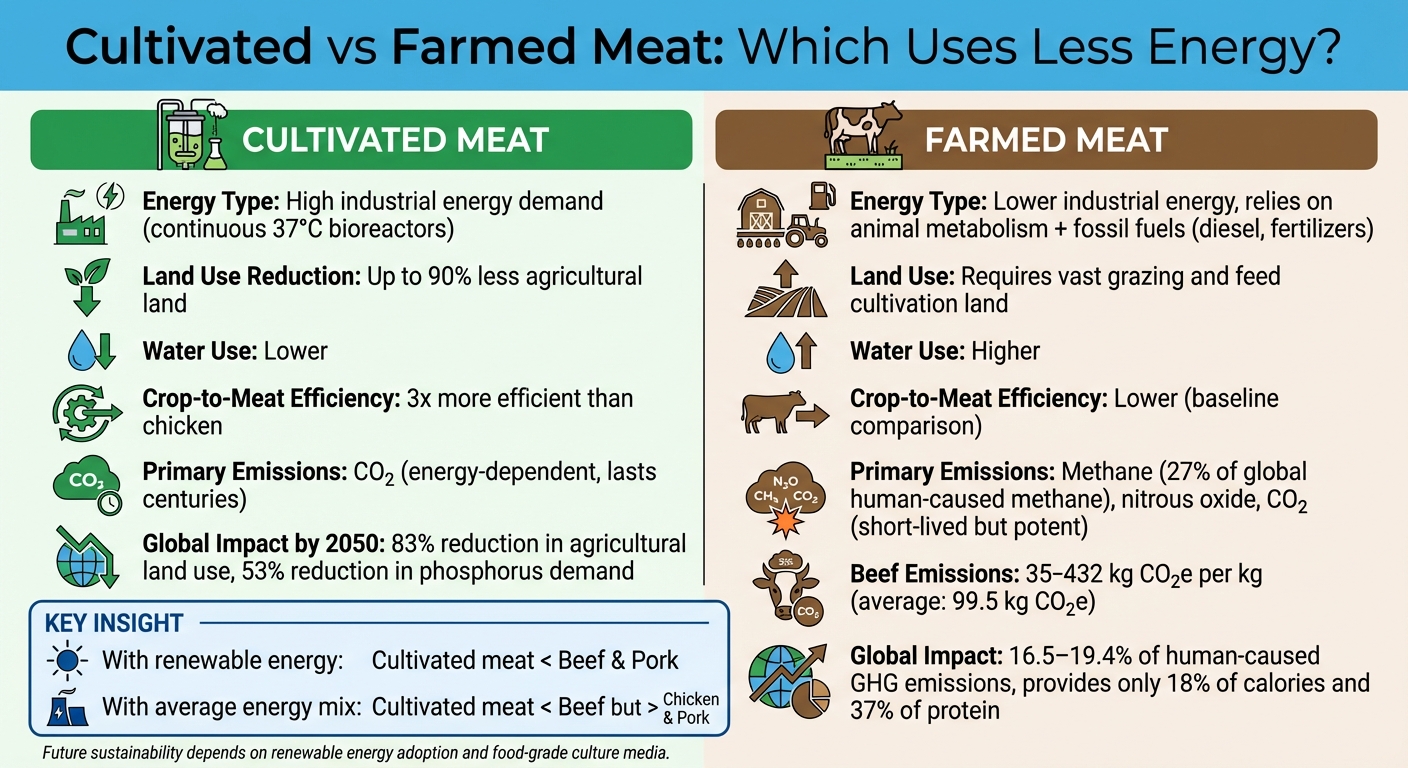
Cultivated vs Farmed Meat: Energy, Land Use, and Environmental Impact Comparison
1. Cultivated Meat
Energy Use in Production
Producing cultivated meat involves swapping the natural metabolism of animals for bioreactors, which maintain a steady temperature of 37°C while stirring cell cultures. Unlike livestock, which generate heat naturally, these bioreactors require constant energy input for heating and power. This industrial approach, particularly the energy needed to maintain reactor conditions and produce culture medium ingredients, makes the process energy-intensive. This sets the stage for understanding how resources are utilised in this production method.
Resource Efficiency
One of the key advantages of cultivated meat is that it avoids the production of non-edible animal parts, leading to much lower resource demands. For instance, fully adopting cultivated meat could cut global agricultural land use by a staggering 83% and reduce worldwide phosphorus demand by 53% by 2050 [7]. These figures highlight its potential for transforming resource efficiency on a global scale.
Environmental Impact
The environmental footprint of cultivated meat hinges largely on the energy sources used during production. If renewable energy powers the process, its carbon emissions can drop below those of beef and pork, making it comparable to chicken [1]. However, when relying on the global average energy mix, its emissions are still lower than beef but exceed those of pork or chicken [2].
"While CM production and its upstream supply chain are energy-intensive, using renewable energy can ensure that it is a sustainable alternative to all conventional meats." - Pelle Sinke, Researcher, CE Delft [1]
Another critical factor is the type of culture medium used. Research from UC Davis has shown that using highly refined, pharmaceutical-grade ingredients could result in a higher environmental impact than beef [4]. To address this, the industry is increasingly turning to food-grade alternatives, which offer a more sustainable path forward. Next, we'll explore how traditional farming methods compare to these advancements.
2. Farmed Meat
Energy Use in Production
Farmed meat production is deeply tied to fossil fuel usage at various stages. Tractors running on diesel are essential for fieldwork, while producing synthetic fertilisers - especially nitrogen-based ones - requires a great deal of energy. On top of that, transporting feed and livestock further adds to fuel consumption [8]. Unlike cultivated meat, which relies on continuous industrial energy inputs, farmed meat benefits from animals' natural metabolism. However, this process is far from efficient, as a large portion of energy is lost before it reaches the consumer. Cultivated meat, by comparison, makes better use of resources.
The energy demands of farmed meat also depend on the farming system in use. For instance, pasture systems in the Midwestern USA are far more energy-intensive than extensive ranching due to higher management needs and greater input requirements [8]. On the other hand, Swedish ranch systems demonstrate how optimised practices can achieve faster weight gain with less energy, showing that management choices can significantly impact resource use.
Resource Efficiency
Farmed meat production consumes vast amounts of land and water. Livestock require enormous areas for grazing and feed cultivation, yet the nutritional returns are relatively modest. Despite the extensive resources used, livestock contribute just 18% of the world's calories and 37% of its protein [1][3]. This inefficiency is largely explained by the feed conversion ratio (FCR) - the amount of feed needed to produce a kilogramme of meat. Chickens are the most efficient among conventional livestock, but even they fall short compared to cultivated meat, which is estimated to be about three times more efficient in converting crops into meat [1].
Environmental Impact
The environmental impact of farmed meat is largely shaped by biological emissions rather than direct energy use. Livestock farming is responsible for 16.5% to 19.4% of human-caused greenhouse gas emissions [1][3]. This includes methane, nitrous oxide, and carbon dioxide, each with unique effects on the atmosphere.
"Cattle systems are associated with the production of all three GHGs... including significant emissions of CH₄, while cultured meat emissions are almost entirely CO₂ from energy generation." - John Lynch, Department of Physics, University of Oxford [8]
Methane emissions from enteric fermentation - a digestive process in ruminants - account for 27% of global methane emissions caused by human activity [1][3]. Beef production from dedicated herds emits between 35 and 432 kg of CO₂e per kilogramme of meat, with an average of 99.5 kg CO₂e [4]. Dairy-integrated beef systems are more efficient, averaging 33.4 kg CO₂e per kilogramme, as the environmental costs are shared between meat and milk production [4]. Beyond greenhouse gases, livestock farming also leads to biodiversity loss and disrupts nitrogen and phosphorus cycles. Fertiliser runoff contributes to over one-third of human-caused nitrogen emissions [1][3]. These factors highlight the environmental challenges tied to farmed meat and set the stage for evaluating its broader sustainability.
Lab-Grown Meat: How Much Can It Help Save Our Climate? | WSJ Tech News Briefing
sbb-itb-c323ed3
Advantages and Disadvantages
Cultivated meat and farmed meat each come with their own set of energy and resource challenges, offering distinct trade-offs.
Cultivated meat stands out for its efficiency in converting crops into meat, achieving up to three times the crop-to-meat conversion rate compared to traditional farming. This efficiency significantly reduces land requirements - cultivated meat needs up to 90% less agricultural land than conventional methods [2][5]. Water usage is also generally lower, and its controlled production environment helps minimise issues like manure runoff and air pollution [1].
That said, cultivated meat is highly energy-dependent. Bioreactors must run continuously, maintaining a steady temperature of 37°C, circulating nutrients, and producing culture medium ingredients - all of which require substantial electricity [1][4]. As previously discussed, the climate impact of cultivated meat hinges on the energy source. With renewable energy, it can achieve a smaller carbon footprint than beef and pork. However, when relying on a typical global energy mix, its emissions may surpass those of chicken or pork [1][2]. Scaling up production poses additional challenges; current 25,000-litre bioreactors would need to expand tenfold to achieve price parity with farmed meat [9].
On the other hand, traditional farming operates with a different set of efficiencies and limitations. Farmed meat relies on well-established methods and utilises animals' natural biological processes rather than continuous industrial energy inputs. However, despite the significant resources required, the nutritional output of farmed meat remains relatively modest. Its greenhouse gas emissions also differ fundamentally: farmed meat produces methane and nitrous oxide, which are potent but short-lived, while cultivated meat primarily emits carbon dioxide from energy use, which lingers in the atmosphere for centuries [1][6].
"Cultivated meat is not prima facie climatically superior to cattle production; its relative impact instead depends on the availability of decarbonised energy generation and the specific production systems that are realised." - John Lynch, Atmospheric Physicist, University of Oxford [6]
The future of cultivated meat will hinge on reducing its reliance on expensive pharmaceutical-grade ingredients and transitioning to food-grade culture media, alongside decarbonising the energy grid. Meanwhile, traditional farming faces the challenge of meeting a projected 70% increase in global meat demand by 2050 without exceeding the limits of available agricultural land [1][3]. These contrasting challenges highlight how innovations and a shift to cleaner energy could transform the landscape of meat production.
Conclusion
When comparing the energy demands of cultivated meat to farmed meat, much depends on how electricity is generated. Cultivated meat is about three times more efficient at turning crops into meat compared to chicken [1]. However, the bioreactors used in its production require a significant amount of energy [1].
The type of energy used is a game-changer. If renewable electricity powers the process, cultivated meat could achieve a smaller carbon footprint than beef and pork, while also competing with chicken on sustainability goals [1][2]. The emissions profile is another key difference: farmed meat releases methane and nitrous oxide, while cultivated meat primarily produces carbon dioxide, which lingers in the atmosphere for centuries [1][6]. This highlights that the long-term climate benefits of cultivated meat hinge on decarbonising the energy grid [6].
Looking to the future, these insights point to the need for technological advancements. Progress will likely include switching to food-grade culture media, scaling up bioreactor sizes beyond the current 25,000-litre capacity, and improving energy efficiency in production facilities [1][4][9]. Companies such as Upside Foods and Eat Just are already pushing towards commercial success, with Eat Just aiming to match conventional meat prices by 2030 [9].
Collaboration will be critical. Producers must prioritise renewable energy and decarbonise their supply chains, while governments need to prepare for the increased demand for renewable energy that this growing industry will bring [1]. As technology evolves and the energy grid becomes greener, cultivated meat could become a genuinely sustainable alternative to traditional meat production.
FAQs
How does the energy source influence the carbon footprint of cultivated meat?
The type of energy used to produce cultivated meat is a major factor in its environmental impact. When the process is powered by renewable electricity, the emissions are far lower than those of conventional beef and are comparable to chicken. On the other hand, if the production relies on energy grids dominated by fossil fuels, the carbon footprint, while still less than beef, surpasses that of pork and chicken.
Using cleaner, sustainable energy sources is essential to fully realise the environmental advantages of cultivated meat, making it a greener option compared to traditional farming practices.
How is cultivated meat more efficient at converting crops into meat compared to traditional farming?
Cultivated meat offers a far more efficient way to transform crops into edible protein compared to traditional livestock farming. Instead of growing and feeding animals, this method skips those steps entirely. Crops are directly used as a growth medium to cultivate meat cells, cutting out the energy usually spent on animal growth, digestion, and upkeep. The result? Cultivated meat achieves about three times better feed-conversion efficiency than even the most efficient livestock, like chickens.
By addressing the inefficiencies of conventional farming, cultivated meat uses fewer resources while still providing real meat. This makes it an exciting and practical alternative for shaping the future of food production.
What environmental challenges are involved in scaling up cultivated meat production?
Scaling up cultivated meat production comes with several environmental hurdles, especially as the industry moves from small-scale experiments to full-scale commercial operations. One major concern is the high energy consumption needed for cell growth. If this energy comes from non-renewable sources, it could lead to considerable greenhouse gas emissions. Transitioning to renewable energy will be essential to lower emissions and deliver on the eco-friendly promise of cultivated meat.
Another significant challenge is scaling up the production of the growth medium - the nutrient-packed solution that sustains cell growth. Recycling this medium efficiently and reducing the use of water-intensive ingredients will play a key role in limiting water consumption and reducing the overall environmental footprint.
On top of that, large-scale bioreactors rely on materials like critical minerals, including copper and rare earth elements, which could put pressure on global supply chains. To address these issues, breakthroughs in bioprocessing, the use of renewable energy, and sourcing sustainable materials will be crucial. These steps are vital to making cultivated meat a practical and environmentally friendly alternative to traditional meat in the UK.


